Muse was never meant to be an app
Everyone is scoring Muse as the next ChatGPT. The bigger bet is an agent that lives inside Meta's ads.
A bull case on a product, not a stock. Nothing here is investment advice.
Muse reached 5 million US downloads in 22 days. ChatGPT took 56. Claude took 492. Meta's personal agent, launched on September 8, topped the US App Store within days, and the coverage has followed one script: can Muse beat ChatGPT?
It's a reasonable question for almost any other AI app. Almost every one of them is built on the same assumption: the app has to win on its own. People have to download it, open it, type into it, come back tomorrow, and eventually pay for it.
Muse is the first big agent that doesn't need that to be true. Meta runs one of the largest ad businesses ever built, across three apps with billions of people already in them. Muse can win as a fourth app. It can also win without becoming one, by making the other three worth more. And the version I find most interesting is one where nobody types a prompt at all, because the ad has already written it.
Most AI apps have to win alone
Look at how the field makes money. ChatGPT and Claude lean on subscriptions. Instinct, the invite-only errand agent, plans to take a cut of what its users buy. Muse itself has both: a free tier, $20 and $100 monthly plans for heavy use, and Zuckerberg telling the Meta Connect audience that Meta expects to "profit by taking a small fee" on transactions.
All of those models share one weakness. They depend on the user choosing the app, again and again. Every dollar starts with someone opening it on purpose.
Meta has never depended on that kind of choice. In the second quarter it booked $59.4 billion in advertising revenue from an average of 3.6 billion people using at least one of its apps every day. That works out to about $16 per daily user per quarter, averaged across the world, and nobody paid a subscription for any of it. Ad impressions grew 14% and the average price per ad grew 12% year over year. The machine that sells attention is still getting better at it.
So when Meta launched an agent, it wasn't launching a product that has to find its customers. Meta pointed up to half of its daily house-ad inventory at Muse in the first weeks. Muse was born inside the distribution.
There are three bets I'm tracking here that could have material impact on Meta's valuation:
- Bet one: a fourth surface. Muse becomes an app big enough to sell ads against, next to Facebook, Instagram and WhatsApp.
- Bet two: Muse makes the other three worth more. It gives Meta a view of life outside its own apps.
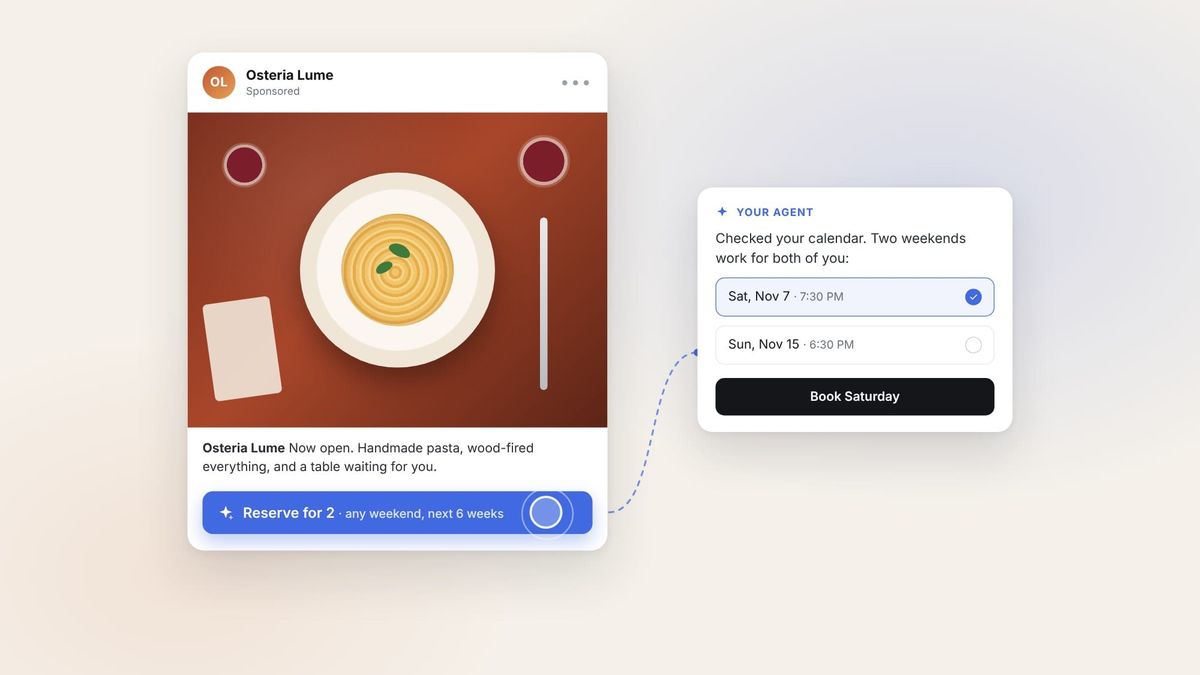
- Bet three: the ad writes the prompt. Muse shows up inside the ads themselves, and the ad does the asking.
Bet one: a fourth surface
Meta has three surfaces at real scale: Facebook, Instagram and WhatsApp. Each one is a place people spend time, and Meta sells that time to advertisers. Muse's download curve is the first thing in years that looks like it could be a fourth.
The free entry point matters more than the price list. A subscription earns more per payer, but most people never pay. An app that costs nothing to start can reach Meta-sized audiences, and Meta knows how to earn money from an audience it doesn't charge.
Today, Muse carries no ads, and Meta has said so. Analysts are already imagining what they might look like, such as sponsored alternatives listed next to the agent's answer. That's a real business if it comes. But I'd hold this bet loosely. Downloads measure curiosity. Daily use measures habit, and the early daily-use number is modest: about 2 million people a day in early October, roughly a third of the Meta AI app's daily users, by one Sensor Tower estimate.
From the trips
When we ran 13 shopping requests through Muse in late September, we saw no sign that it favoured Meta's own paid placements. Most of its open-web picks came from ordinary retailers, and Muse told us its Marketplace search doesn't return a "sponsored" field at all. For now it shops like it works for the shopper.
That last point- that Muse works for the shopper- is worth keeping. An agent that steers you to whoever paid stops being worth asking. If Muse becomes a fourth surface, its ads will have to look different from feed ads.
Bet two: Muse makes the other three worth more
Even if Muse never becomes a destination, it gives Meta something it has never had: a view of life outside its own apps. Email. Calendars. The errands people actually run. For an ad business, that's the missing half of the picture.
Here I want to be careful, because Meta has been explicit. Its launch post says Muse doesn't share a person's conversations, or the data in their private Muse workspace, with Meta's ad systems. That's the promise today, and I'm not predicting Meta breaks it.
It's still worth knowing the precedent. In October 2025, Meta announced that conversations with Meta AI would be used to personalize ads and content on Facebook and Instagram, starting that December, with sensitive topics excluded. The line between "assistant" and "ad signal" has moved before.
But the stronger version of my argument doesn't need that line to move.
Bet three: the ad writes the prompt
Picture a sponsored post on Instagram for a new restaurant across town. Today the best that ad can do is send you somewhere else: a profile, a website, a booking page in a browser. Each hand-off loses people.
Now picture one button on that post: Reserve for 2, any weekend in the next six weeks.
You didn't type anything. The ad supplied the restaurant, the location and the offer. Muse supplies what it already knows about you, inside its own wall: your calendar, who you usually eat with, the time you prefer. It checks availability, comes back with two options, and books the one you tap.
Call it contextualized prompting: the prompt arrives pre-written by the thing you're already looking at. It's the reverse of how we use agents today. Today, the user carries context to the agent, one typed instruction at a time. Here, the context comes to the user, and the user only has to say yes.
Notice what doesn't have to happen. No private data flows from Muse to the ad system. The information flows the other way: from the ad into the agent. That's why I think this is the most defensible version of the bull case. It works inside Meta's current promise.
Meta has been laying the pipes for years. Instagram has let restaurants and service businesses put reservation and booking buttons on their profiles, with partners like OpenTable, Resy and Tock. Last October Meta launched Business AI, an agent brands can place inside Facebook and Instagram ads and messaging. And at the end of September, Meta opened Muse to small businesses, connected to Shopify, Instagram analytics, Facebook pages and Meta ad accounts. The advertiser side is getting wired up at the same time as the consumer side.
From the trips
In September we asked Muse six times about a table for a group at one Chicago restaurant. All six attempts got the hard part right: the evening slot we asked for wasn't available, and only one earlier time could seat the whole group.
Why does this matter commercially? Three reasons:
- Better experience. One tap replaces a chain of screens.
- Time in the app. The booking finishes inside Instagram instead of leaking to a browser.
- A more valuable ad. An ad that can complete a reservation is worth more than one that earns a click and hopes. Advertisers pay for outcomes, and this moves the ad closer to one.
The click was the unit of the last ad era. The completed task could be the unit of the next one, and Meta is the company best placed to sell it.
What would prove me wrong
I'm building in agentic commerce, so I'm inclined to believe agents change everything. Here's what would change my mind.
Habit doesn't form. Two million daily users is a promising start and a small number next to Meta's billions. If Muse's daily use stalls, the fourth-surface bet weakens, though the ad-button bet survives because it doesn't need anyone to open Muse.
Trust breaks. Muse remembers a lot. TIME reported this month that it keeps detailed notes on users and the people they mention. If people decide the agent knows too much, they won't connect their email or calendar, and the button loses most of what makes it smart.
Merchants say no. Amazon started blocking Muse from its site on September 20 and asked Meta to remove Amazon from the experience. Every business that treats agents as a threat is a button that can't be built.
Meta has tried this before. Booking buttons on Instagram have existed for years without becoming the main way anyone books dinner. The new part is the agent doing the work in between, and that's still unproven at scale.
What I'm watching: whether a Muse action shows up inside a Facebook or Instagram ad format within the next year. If it doesn't, I'm wrong about where Meta is going.
What this means if you're not Meta
If you advertise, start thinking of the ad as the first step of a task. The question becomes: can an agent actually complete what your ad offers? Can it see your availability, your prices, your stock? If it can't, the button can't exist for you.
If you're building an AI app, ask which surface you ride on. Most standalone apps are betting they can become the place people go. Meta can win if Muse never becomes that place.
Everyone is asking whether Muse can become the next ChatGPT. I think Meta needs something smaller and worth more: an ad that finishes the job.